Why the Best Essays Start with a "No"

It started with an argument with my dad.
Just a few days before I came across the John Locke Institute Essay Competition, we had one of those conversations that starts normally and somehow ends with both people being very convinced that the other person is completely wrong.
The subject this time was mental health.
My dad thought that mental health had become a trend. With teenagers talking about anxiety, ADHD, depression and burnout all over social media, he wondered whether people were sometimes turning perfectly normal struggles into disorders. I disagreed. I thought mental illness wasn't suddenly appearing everywhere. We were simply talking about it more than we used to.
Neither of us was particularly interested in surrendering. And then, rather conveniently, I found an essay competition asking almost exactly what we had been arguing about: Is mental health over-diagnosed or just better recognised now? I had never written about psychology before. In fact, this was also my first time entering the John Locke competition. So I had no idea where the question would take me. I only knew that I had already been arguing about it at home, which seemed like a reasonably good place to start.
What followed was a rather humbling process of discovering that I wasn't quite as certain as I thought I was. I started looking for answers and kept finding more questions. I found arguments that seemed to support my dad. Then I found evidence that challenged them. I came across the Rosenhan experiment, thought I had found a rather convincing answer, and then discovered that even that famous experiment was far more complicated than I had assumed.
Eventually, the essay stopped being about proving whether my dad or I was right. And that is where this essay began. Find my essay here: https://dhamathisuresh.wixsite.com/website/post/when-suffering-finds-a-name
Next came the interview and the English test, the final stages of the competition. The former may well have been more daunting of the two. While writing an essay required me to think through my ideas, the interview allowed me to go further by having me defend and even question my arguments. The English test posed an entirely different set of challenges, yet both were definitely a great addition to the competition.
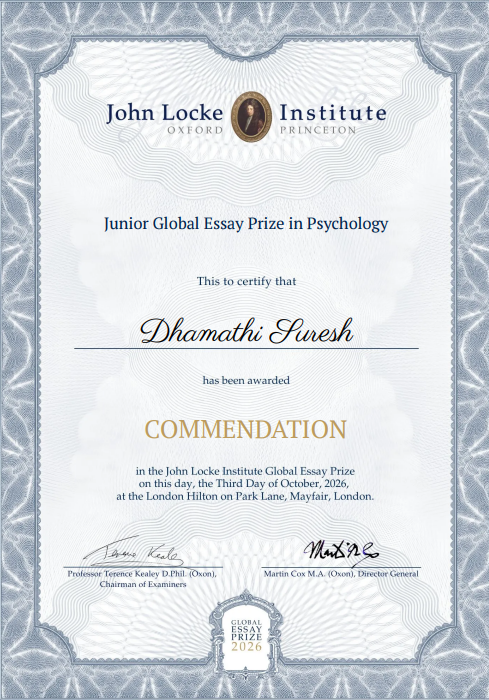
And then the results came. I won a Commendation in the Junior Category for Psychology. And I couldn't be happier.
This was my first time entering the John Locke Essay Competition, as well as my first try at writing a proper essay on psychology. I began with an argument with my dad and then proceeded to research the topic of psychiatric diagnosis, to doubt Rosenhan's experiment, take part in the interview and the English test and get the commendation for my essay.
I’m so relieved I entered. Not just for the outcome, but for the reminder that sometimes the best way to start an essay is just to begin by saying something you absolutely cannot agree with.


Comments